
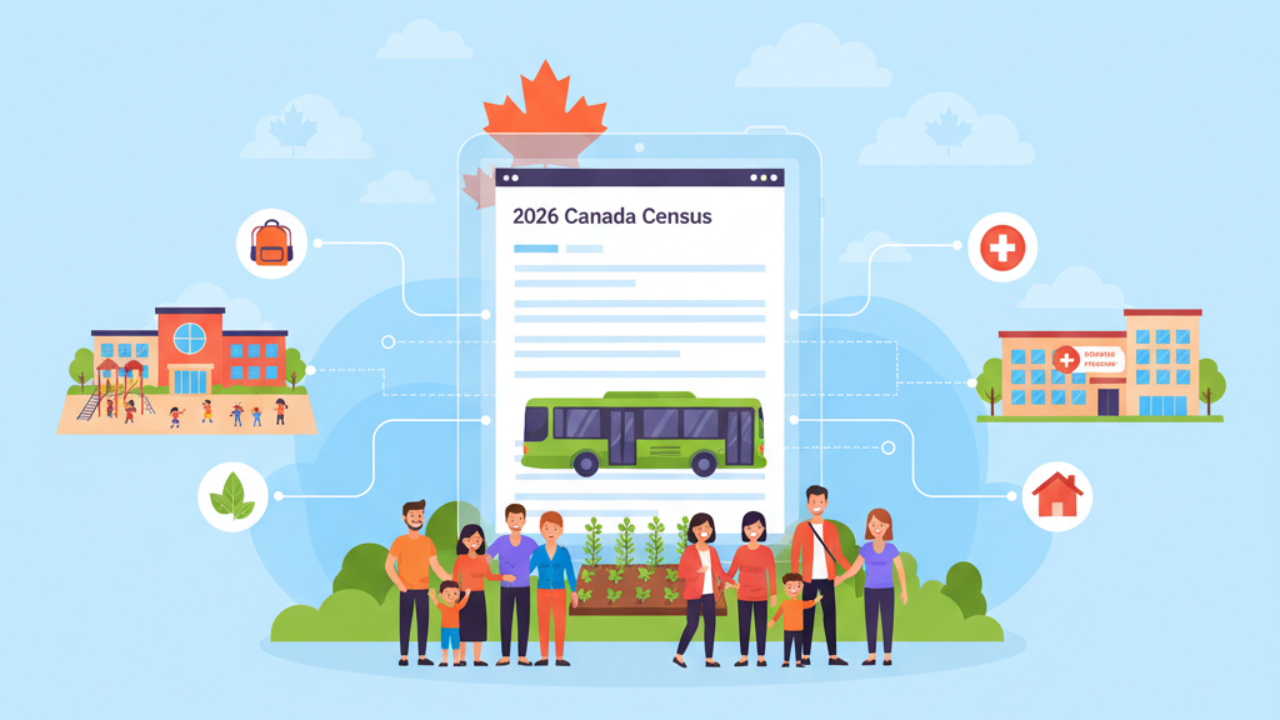
Have you ever wondered how a new school suddenly appears in a growing suburb, or why a specific bus route gets extended just when you need it? These aren't just happy accidents. They are the direct result of a massive, nationwide "check-in" that happens every five years.
In May 2026, millions of Canadians will receive an invitation in the mail (or at their door) to participate in the 2026 Census of Population. While it might feel like just another task on your to-do list, filling out your census is one of the most powerful, direct ways you can advocate for your community. It is the "gold standard" of data that shapes everything from your local walk-in clinic to the playground down the street.
Let’s dive into why the 2026 Census is much more than a head count—it’s a roadmap for Canada’s future.
What Exactly is the Census?
At its simplest, the census is a snapshot of who we are and where we live. Conducted by Statistics Canada, it provides a statistical portrait of our diverse population. It captures demographic, social, and economic information that helps us understand how our country is changing.
In Canada, participating in the census is actually a legal requirement under the Statistics Act. But beyond the legal obligation, there is a profound social contract at play. By telling the government who you are and what your household looks like, you are essentially saying, "We are here, and these are our needs."
The Power of "Small" Data for Big Community Wins
When we talk about "big data," it often feels abstract. But census data is incredibly local. It drills down into your specific "dissemination area"—basically, your neighbourhood block. Here is how that information turns into real-world community development:
1. Healthcare Where You Need It
Provincial and territorial governments don't just guess where to build hospitals. They use census data to map out population density and age distribution. If a neighbourhood has a sudden influx of young families, the data signals a need for more pediatric services and prenatal care. Conversely, in areas with a growing number of seniors, the data justifies investments in community health services and specialized geriatric care.
2. Schools, Daycares, and the Next Generation
Local school boards rely heavily on census trends to predict future enrollment. If the 2026 Census shows a "baby boom" in your postal code, it provides the evidence needed to secure funding for new schools or additions to existing ones. It also helps plan for Canada Child Benefit allocations and the placement of subsidized daycare spots.
3. Fixing the Commute
Are you tired of waiting 20 minutes for a bus that’s already full? Municipal transportation planners use census information to analyze traffic flows and commuting patterns. By looking at how many people in your area work from home versus those who travel to a downtown core, cities can adjust public transit routes and plan for road expansions or bike lanes that actually make sense for the residents.
4. Emergency Services and Safety
Seconds count in an emergency. Fire departments and police services use census data to determine where new stations should be built to ensure the fastest response times. They also use the data to understand the language profiles of a neighbourhood, ensuring they have the right translation resources available for first responders.
Addressing the Housing Crisis
We all know that housing is one of the biggest challenges facing Canadians today. The 2026 Census includes critical questions about housing costs, the age of our homes, and household composition.
The Canada Mortgage and Housing Corporation (CMHC) uses this data to identify which areas are struggling most with affordability. When you fill out your form, you are providing the evidence needed for "core housing need" assessments, which ultimately drive government investment in affordable housing projects and rental assistance programs.
Beyond the Numbers: Inclusion and Representation
Canada is a mosaic, and the census is the only tool that truly captures the nuances of that diversity.
Supporting Indigenous Communities
Indigenous communities and organizations use census data to evaluate the success of health and social programs. For First Nations, Métis, and Inuit people, accurate data is a tool for self-determination, helping to secure grants for economic development and community-led education initiatives.
Visibility for Minority Groups and People with Disabilities
Data from the census is used to identify barriers faced by visible minorities and people with disabilities. It helps community organizations advocate for better employment services and accessibility improvements. Without this data, these groups risk becoming "invisible" in the eyes of policy-makers.
Is My Information Safe?
It is natural to feel a bit hesitant about sharing personal details with the government. However, Statistics Canada is bound by law to protect your privacy.
- Confidentiality: Your individual answers are never shared with the police, the CRA, or any other government department in a way that identifies you.
- Encryption: The online portal uses the same level of security as major Canadian banks.
- Anonymity: When the results are released, they are grouped together (aggregated) so that no single person or household can be identified.
Statistics Canada has a long-standing reputation for maintaining the highest standards of data security, ensuring that your participation is both safe and impactful.
How to Participate in 2026
In early May 2026, households across Canada will receive an invitation letter with a unique 16-digit secure access code.
- Go Online: This is the fastest and most environmentally friendly way. Visit the official census website and enter your code.
- Short-Form vs. Long-Form: Most households will receive the short-form questionnaire (basic demographics). About one in four households will receive the long-form, which asks more detailed questions about education, labour, and housing.
- Telephone or Paper: If you don't have reliable internet access, you can call the Census Help Line to complete it over the phone or request a paper copy.
The Collective Impact
It is easy to think, "I'm just one person, my form won't change anything." But community development is a game of aggregates. When a whole neighbourhood participates, the "data signal" becomes impossible to ignore.
Think of the census as a collective vote for your neighbourhood's future. It is a way to ensure that your tax dollars are returned to your community in the form of the services you use every day.
Moving Forward Together
Filling out the census is a small act of Canadian citizenship that carries a massive weight. It is the foundation upon which our cities are built and our social programs are designed. When the 2026 Census arrives, take twenty minutes to tell Canada who you are. By doing so, you aren't just completing a form—you are helping to build a more inclusive, well-resourced, and vibrant community for yourself and your neighbours.
Let's make sure everyone in our "True North" is counted, because the portrait of Canada isn't complete without you.