
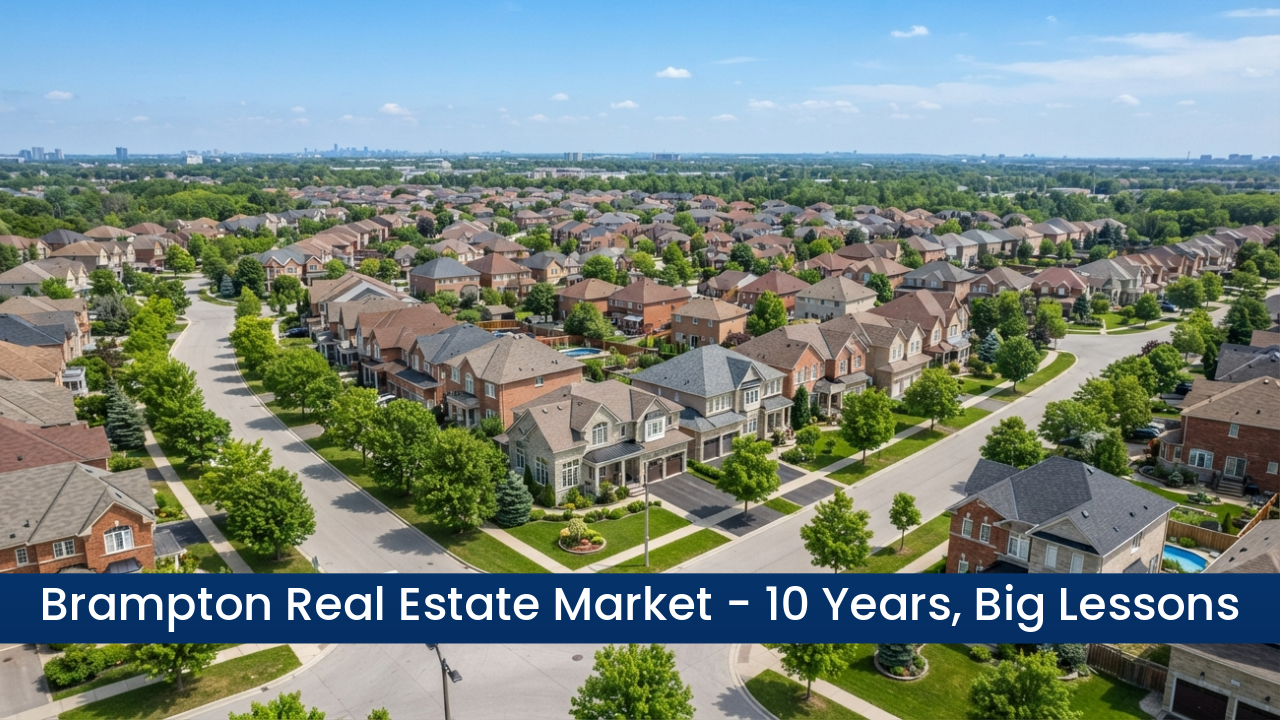
Ten years is a long time in real estate. Long enough to watch a quiet Peel Region suburb turn into one of the hottest markets in the Greater Toronto Area, then cool off, then find its footing again. If you have owned a home in Brampton since 2015, you have lived through one of the wildest housing stories in Canada. If you are thinking about buying or selling here now, that history has a lot to teach you. This blog walks through what actually happened in the Brampton real estate market over the last decade, why it happened, and what buyers and sellers should take away from it.
Where Brampton Started: 2015
In late 2015, the average home price in Brampton sat around $488,500. Detached homes in established pockets like Bram West and Credit Valley were selling in the $580,000 to $640,000 range. Homes typically sold within three weeks, and buyers were paying close to the asking price, not far above it. By today's standards, this looks almost quaint.
At the time, Brampton was known as an affordable alternative to Toronto and Mississauga. Commuters priced out of the city core moved west along the 401, 410 and 407 corridors, and builders kept pace with steady, manageable growth. Nobody was calling it a bubble because, frankly, it did not look like one yet.
The Climb: 2015 to 2020
This is where the story starts to change. Between 2015 and 2020, the average resale price of an existing home in Brampton jumped by roughly 71% in Dec 2020 to $839,171 due to Low interest rates, a growing population, and Brampton's reputation as a more affordable suburban option in the GTA all pushed demand higher year after year.
Prices did not move in a straight line. There was a brief cooling when the Ontario government introduced the 15% Non-Resident Speculation Tax (Ontario) in 2017 & 2018, and introduced strict mortgage stress test rules. But the dip was short-lived. By 2019, the Brampton real estate market was climbing again, fuelled by strong immigration and buyers stretching their budgets to get into the market before prices rose further.
The Pandemic Peak: 2021 to Early 2022
Then came the pandemic, and with it, the most dramatic run-up Brampton has ever seen. Rock-bottom interest rates, remote work, and a rush for more space sent buyers from Toronto and beyond into Brampton in record numbers. Bidding wars became routine. Detached homes that had sold for around $700,000 a few years earlier were suddenly listing for well over a million dollars.
The peak came in February 2022, when the average price of a home in Brampton hit roughly $1.3 million, and the average price of a detached home in Brampton hit roughly $1.6 million. Some neighbourhoods, including the Vales of Castlemore, saw average detached prices climb past $2 million. It was an extraordinary moment, and for many long-time homeowners, it meant real, life-changing equity gains. But for buyers entering the market at that peak, it set the stage for a hard landing.
The Rental Side Pushed Prices Up Too
Home prices weren't just about owner-occupiers. A big piece of the story, especially from around 2017 through 2023, is rental demand, fed largely by international students on study permits and temporary foreign workers, many of whom made Brampton home. Ontario took in more international students than every other province combined during those years, and a large share landed in Brampton, packing into basement apartments and shared rentals to make the numbers work.
That surge in renters made Brampton attractive to investors. With basement units and rooms renting out fast and rents climbing through 2021 and 2022 in particular, investor-buyers saw a reliable income stream. They were willing to pay more to secure it, which added extra fuel to the price run-up alongside owner-occupier demand. When Ottawa cut study permit numbers in 2024 and 2025, that rental pressure eased, and it's part of why demand and prices have softened since.
The Correction: 2022 to 2024
The Bank of Canada began raising interest rates in March 2022, moving quickly from 0.25 percent to well over 4.25 percent within months. Banks' prime rate reached 6.45% in Dec 2022. The effect on the Brampton real estate market was immediate and severe. By Dec 2022, the average detached home price had fallen to about $1.15 million, a drop of more than 29 percent from the February peak.
This period produced one of the more painful stories of the decade: pre-construction buyers who had signed deals during the frenzy found themselves unable to secure financing or close on homes that were now appraised far less than their purchase price. Some walked away from deposits. Others scrambled to renegotiate. It was a sharp reminder that leverage cuts both ways.
By Dec 2024, the market had largely stabilized, with average detached resale prices sitting around $1,101,428, and average homes sold for $948,084 still firmly in what local agents call the "million-dollar club," even though well below the 2022 peak.
Where Things Stand: 2025 to 2026
The correction was not finished. Through 2025, the average residential sale price across all property types in Brampton fell a further 6.9 percent year-over-year, landing around $882,661 in Dec 2025. Sales volume dropped nearly 13 percent, while the number of active listings jumped almost 20 percent. In plain terms: more homes for sale, fewer buyers ready to commit, and softer prices.
Economic uncertainty, job insecurity, ongoing conflict in the Middle East, and rising cost-of-living pressures have kept many potential buyers on the sidelines. In July 2026, the Bank of Canada maintained key interest rates for the sixth consecutive time. Brampton is anticipated to continue being a buyer's market in the near term, representing a significant shift after years during which sellers held nearly all the leverage.
The Big Lessons From the Last Decade
A few patterns stand out when you look back at ten years of the Brampton real estate market:
- Interest rates matter more than almost anything else. The single biggest swings in price, both up in 2020 to 2022 and down afterward, tracked closely with the cost of borrowing. Buyers and sellers who understand this can time their decisions more wisely.
- Population growth is Brampton's long-term engine. Brampton remains one of Canada's fastest-growing cities, and that growth underpins housing demand even through short-term corrections. This is a big part of why prices have not collapsed the way some feared in 2022 and 2023.
- Detached homes carry the most risk and the most reward. Detached properties saw the sharpest gains during the boom and the sharpest losses during the correction. Townhomes and condos have generally moved with less drama, which makes them a steadier option for buyers who are nervous about volatility.
- Leverage can turn a good decision into a bad one. The buyers who struggled the most in 2022 and 2023 were often those who stretched their budgets at the top of the market. A margin of safety matters, especially when rates can move as fast as they did.
- Local data beats headlines. National and GTA-wide numbers rarely tell the full Brampton story. Prices, days on market, and buyer behaviour can differ significantly between neighbourhoods like Mount Pleasant, Bramalea, and Credit Valley. Anyone serious about the Brampton real estate market should look at community-level reports, not just city averages.
Why Power of Sale Listings Run High in Brampton
Brampton has one of the GTA's highest concentrations of power of sale properties. During the low-interest years, many buyers stretched their budgets by pulling equity from existing homes to fund down payments on second investment properties. When property values dropped, this strategy failed: the second properties were worth less than the debt owed, rental income could not cover rising carrying costs, and equity disappeared.
The Lesson for Homeowners and Investors: Leverage that works at 2% interest and peak appraisals can break you when interest rates rise and prices fall. Maxing out borrowing capacity or pyramiding equity from one property into another leaves zero margin for error. Brampton is a clear example of what happens when that financial cushion runs out.
What This Means Going Forward
The last ten years turned Brampton from an affordable commuter suburb into a market that briefly rivalled some of the priciest corners of the GTA, and then pulled back to something closer to balance. That arc says less about Brampton itself and more about how sensitive Canadian housing is to interest rates, immigration policy, and buyer psychology.
For anyone watching the Brampton real estate market today, the lesson is not to chase the last cycle's winners. It is to understand what actually drove the swings, borrow within your means, and pay attention to local, neighbourhood-level data rather than headlines alone. Whether you are buying your first townhome, watching your detached home's value settle after 2022, or exploring a power of sale opportunity, the fundamentals that mattered over the last decade will likely matter over the next one too: interest rates, population growth, and how much room you leave yourself if things do not go exactly as planned.