
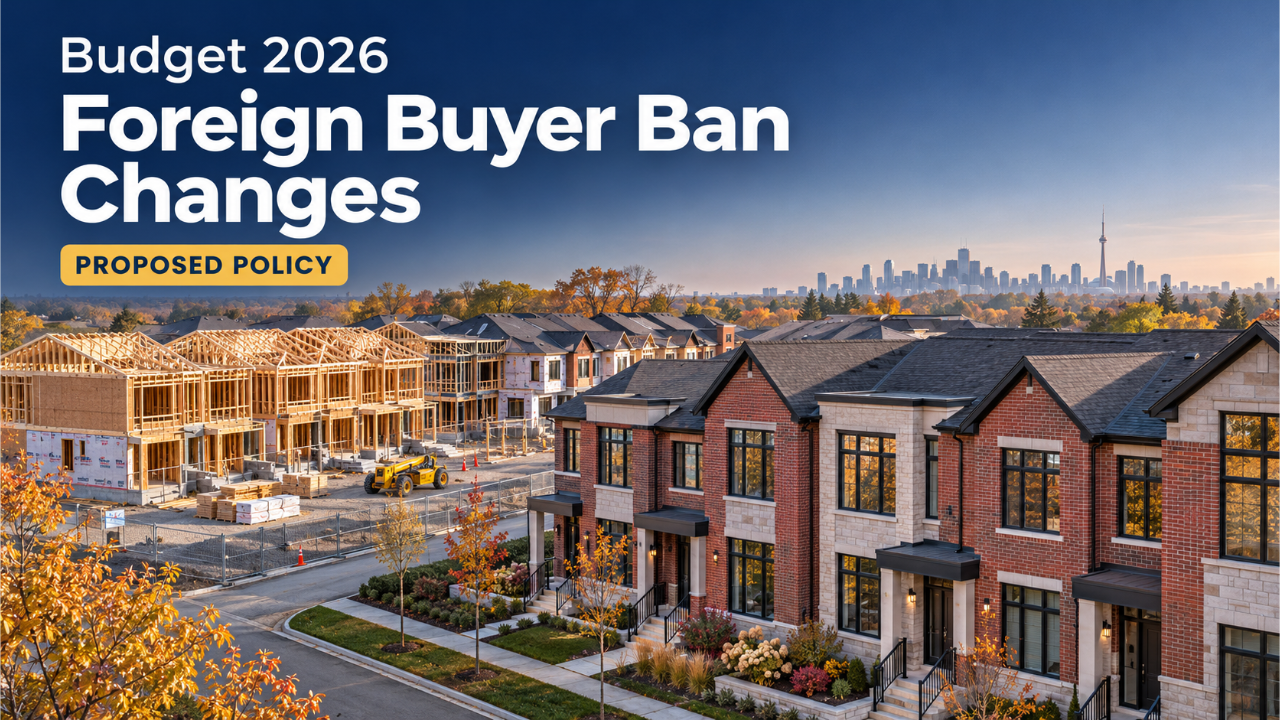
The federal government’s Budget 2026 proposes extending Canada’s foreign buyer ban on existing residential properties to January 1, 2029, while exempting new residential properties.
The proposal would create a distinction between foreign purchases of existing housing and investment in newly built homes. For buyers, builders and sellers across the Greater Toronto Area, its practical effect will depend on the legislation and regulations that follow.
The announcement does not establish that a new-home exemption is already available. Buyers should confirm the rules in force before signing a purchase agreement.
Proposed extension would apply to existing homes
According to Chapter 3 of Budget 2026, the government proposes a two-year extension of the prohibition for existing residential properties, alongside an exemption for new residential properties.
The government describes the measure as a way to preserve Canadians’ access to existing housing while attracting investment into additional supply. It says legislation and a regulatory process will follow.
The budget’s legislative measures annex also identifies the proposed extension of the Prohibition on the Purchase of Residential Property by Non-Canadians Act.
The broad direction is clear. However, buyers still need transaction-level guidance before relying on the proposed exemption.
Important details remain unresolved
The published budget measure does not provide a detailed definition of “new residential properties” or specify the exemption’s start date.
Those details matter because the new-home market includes several different types of transactions. A direct purchase from a builder may raise different questions from an assignment or a recently completed home offered by an individual owner.
The final rules will need to clarify the treatment of situations such as:
- Pre-construction homes purchased directly from builders.
- Completed homes remaining in builder inventory.
- Recently completed properties offered for resale.
- Assignments of existing purchase agreements.
- Converted or substantially renovated properties.
These examples identify questions to investigate. They are not a confirmed list of qualifying properties.
Descriptions such as “never lived in” or “brand new” should not be treated as proof that a property qualifies. The final legal definition will determine the result.
Who is affected by Canada’s foreign buyer ban?
The legislation is formally called the Prohibition on the Purchase of Residential Property by Non-Canadians Act.
“Foreign buyer” is a common shorthand, but a person’s eligibility depends on the legal definitions and applicable exceptions.
Canadian citizens and permanent residents are outside the prohibition. Some other purchasers may qualify under existing exceptions, subject to specific requirements. Buyers can consult CMHC’s frequently asked questions and the federal Act.
For example, a permanent resident shopping for a Brampton townhome should not assume they are prohibited from buying because they have not obtained Canadian citizenship.
A temporary resident should also avoid assuming that employment in Canada automatically settles their eligibility. The relevant exception and its requirements need to be reviewed.
Buyers whose circumstances raise questions should obtain legal advice before making a binding commitment.
Ontario foreign buyer taxes require separate attention
A federal exemption would not, by itself, remove Ontario’s foreign purchaser tax.
Ontario identifies a 25 per cent Non-Resident Speculation Tax, or NRST, on applicable residential property acquisitions by foreign nationals, foreign corporations and taxable trustees, subject to the relevant rules.
The province explains the framework in its land transfer tax and NRST information.
This creates two separate checks for a potentially affected buyer: whether the purchase is permitted and which taxes apply.
For illustration, if a hypothetical $1 million acquisition were subject to Ontario’s 25 per cent NRST, that tax alone would equal $250,000. This calculation does not determine whether a particular purchaser owes the tax or provide a complete estimate of closing costs.
Before evaluating affordability, buyers need a cost review that addresses their status, the property and any applicable exemptions.
Toronto has an additional municipal tax
Properties within the City of Toronto require an additional review.
Toronto’s Municipal Non-Resident Speculation Tax, or MNRST, applies at 10 per cent to certain residential purchases by foreign buyers, effective January 1, 2025.
The City of Toronto’s official guidance explains its application and available exemptions.
The federal proposal does not itself announce relief from this municipal tax.
Buyers comparing properties across the GTA should identify the municipality for each property. A Toronto address and a property in Vaughan, Mississauga or Brampton should not be assumed to have identical tax treatment.
Federal eligibility, provincial taxation and municipal taxation each require their own assessment.
Potential implications for new-home developments
The proposed exemption could broaden the potential purchaser pool for qualifying new-home projects. Whether that leads to meaningful additional sales or construction remains uncertain.
One possible market effect is that additional purchases help some developments progress towards their sales and financing requirements. That is a potential pathway, rather than a result established by the announcement.
Projects would still need suitable financing, approvals, servicing and purchasers able to complete their transactions.
Buyers would also continue to consider price, location, expected completion, financing and ownership costs. Provincial or municipal foreign purchaser taxes could influence whether a purchase makes financial sense.
The eventual impact should therefore be assessed through project progress and completed housing, alongside sales activity. A change in purchasing eligibility cannot establish those outcomes in advance.
What Canadian buyers should consider
Canadian buyers may wonder whether an exemption would increase competition for new homes or improve future housing supply.
The effects could vary by project, neighbourhood and property type. A development attracting additional purchasers could experience different conditions from another project with limited interest.
Any longer-term supply benefit would depend on developments advancing into construction and completed homes.
For buyers deciding between a new home and a resale property, the immediate work remains the same: compare the full cost and suitability of each option.
That review should include the deposit schedule, expected mortgage payments, taxes, maintenance costs and cash needed at closing. Buyers should also assess how much uncertainty their household can manage.
A purchase should remain workable without relying on a prediction that the policy will push prices higher.
Resale sellers still need local pricing evidence
The proposed exemption for new residential properties should not be treated as evidence that every resale home will attract more buyers or command a higher price.
A seller in Caledon, Brampton or elsewhere in the GTA still needs to assess recent comparable sales, competing listings, property condition and buyer feedback.
For example, a national policy announcement cannot establish the value of a particular lot, renovation or floor plan. Those features need to be compared with properties buyers can actually choose.
The same approach applies when reviewing an offer. Price, conditions, timing and the seller’s circumstances should guide the discussion.
Canada’s foreign buyer ban forms part of the broader housing environment. It does not replace local evidence when pricing or negotiating a specific transaction.
A practical example for a prospective purchaser
Consider a non-Canadian buyer enquiring about a completed builder townhome in Vaughan after reading the budget headline.
Before reserving the property, the buyer would need answers to several questions. Has the exemption taken effect? Does that home qualify? How do the rules apply to the agreement date? Would Ontario’s NRST apply?
The purchaser would also need financing suitable for their circumstances and enough cash to meet the deposit and closing requirements.
A useful first step is to gather the property details, draft agreement and purchaser information for legal and financing review.
This turns a general announcement into an assessment of an actual purchase. An advertised price or an expected future closing date cannot answer those questions on its own.
What to watch next
The next developments to monitor are the proposed legislation, regulations and implementation guidance.
Buyers and industry professionals should look for clarification on:
- The definition of qualifying new residential properties.
- The exemption’s effective date.
- Relevant agreement dates and transitional provisions.
- The treatment of assignments and completed inventory.
- Documentation needed to establish eligibility.
Until those details are available, marketing should accurately describe the measure as proposed.
A buyer considering a purchase can prepare by confirming their current eligibility, obtaining a full cost estimate and reviewing the agreement with a real estate lawyer.
The most useful question is specific: “Am I permitted to buy this property under the rules currently in force?”
Following the proposal through to implementation
Budget 2026 proposes a different approach to foreign purchases of existing and new housing. Its practical effects will become clearer as the government publishes the measures needed to implement it.
For now, prospective purchasers can use the announcement to organise questions and compare properties. They should base commitments on confirmed eligibility, realistic costs and advice relating to the actual transaction.
Condo Plus Home will continue to cover housing policy developments and explain what they could mean for people exploring new homes across Ontario.
This article is for informational purposes only. Please check current regulations and seek professional advice before purchasing a property. Information reviewed as of November 7, 2026.