
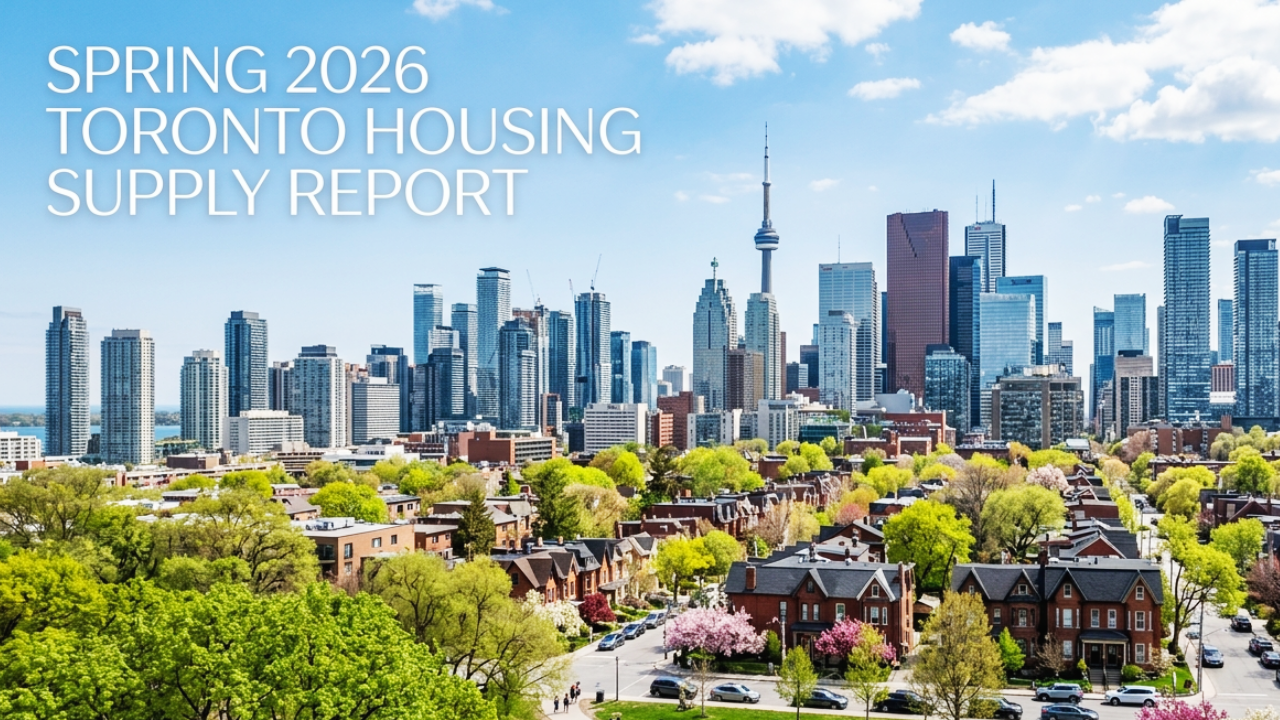
Welcome to the spring real estate market! If you are thinking about buying, selling, or investing in the Greater Toronto Area this year, you likely have one big question on your mind: What is happening with the housing inventory? As a realtor, I spend my days helping clients navigate the realities of our local market. To give you the best advice, I rely on hard data rather than headlines. The Canada Mortgage and Housing Corporation (CMHC) recently released its highly anticipated Spring 2026 Housing Supply Report. This document provides a deep, data-driven look at what builders constructed last year, what is currently under development, and what is sitting unsold.
In this blog, I will break down the report for you. We will look beyond the complex economic jargon and focus solely on what the current Toronto housing supply means for you in 2026.
The Big Picture: Canada Builds While Toronto Lags
To understand our local market, we first need to look at the national landscape. According to the CMHC Spring 2026 Housing Supply Report, housing construction across Canada remained surprisingly resilient over the last year. Nationally, housing starts rose by 6%, bringing 259,000 new units into the pipeline.
However, Toronto tells a very different story.
While cities like Calgary, Edmonton, and Vancouver saw construction levels soar past their 10-year historical averages, Toronto experienced a significant slowdown. In fact, among Canada’s seven largest metropolitan areas, Toronto recorded the lowest per-capita level of new housing starts.
Let us look at the hard numbers for the Toronto market compared to our 10-year historical average (2016–2025):
-
Apartment starts (Condos and Rentals): Toronto saw 18,986 starts, which is a steep drop from our 10-year average of 26,856.
- Ground-Oriented Starts (Detached, Semi-Detached, and Townhouses): Toronto recorded only 7,101 starts, falling far short of the 10-year average of 11,760.
Why is the Toronto housing supply shrinking when the rest of the country is building? The CMHC data points to three main culprits: slower population growth, highly cautious buyers, and elevated construction costs. Developers simply cannot afford to build if they cannot guarantee buyers, which leads us directly to the current state of the condominium market.
The Condo Market: A Tale of Unsold Inventory
If you have driven through downtown Toronto or North York recently, you might assume we have an endless supply of condominiums. The physical buildings are there, but the financial mechanics behind them have shifted drastically.
The CMHC report highlights a major vulnerability in our housing system: condominium presales have collapsed.
Historically, developers in Toronto rely heavily on pre-construction sales. They need a large percentage of a building sold before a bank will finance the construction. Because financial conditions have tightened and buyers are acting with extreme caution, developers are struggling to hit those vital presale targets. As a result, many planned projects are either paused or cancelled entirely.
Furthermore, the supply of unsold condominium inventory at completion surged in Toronto. We are seeing double-digit increases in completed units that sit empty.
Realtor's Takeaway for You: We are currently sitting in a strange, short-term imbalance. Right now, there is an excess of completed, unsold condos. If you are a buyer looking to purchase a condominium this spring, the power is firmly in your favour. You have options, and you have negotiating room. However, because developers are cancelling future projects today, we are going to see a massive tightening of the Toronto housing supply in a few years. If you plan to buy, buying into this temporary oversupply might be a very smart long-term move.
The Bright Spot: Record Rental Construction
While the ownership-oriented supply chain struggles, there is a silver lining in the CMHC report. Rental construction is booming.
Purpose-built rental construction actively drove overall new housing supply across the country, and Toronto is no exception. Last year, Toronto posted its second-highest level of rental starts ever.
Why does this matter to you if you want to buy a home? It matters because of a real estate concept called "filtering."
As new, high-quality rental buildings are completed and enter the Toronto housing supply, higher-income renters often move into them. This movement frees up older, more affordable rental units for middle- and lower-income tenants. Over time, a healthy rental market reduces the frantic pressure on the entry-level homeownership market.
The CMHC report projects that this influx of rental supply will continue to ease the rental market over the next three years. This means less aggressive rent growth, giving young professionals and families a chance to save for their down payments without being entirely squeezed by their monthly rent cheques.
The Rise of the Missing Middle and Neighbourhood Conversions
One of the most fascinating trends revealed in the Spring 2026 report is how developers are adapting to the current economic climate. Because massive high-rise condominiums are difficult to finance right now, and sprawling single-detached homes are too expensive for the average family, builders are pivoting to the "missing middle."
Missing middle housing includes accessory suites, multiplexes, row homes, stacked townhouses, and low-rise apartments. These homes are quicker to build, cost less to construct, and fit seamlessly into our existing residential neighbourhoods.
The data shows a massive shift in how Toronto is building:
- Roughly 40% of all new housing starts in Toronto now fall into the missing middle category.
- Incredibly, small plex-style apartments (buildings with 3 to 5 units) now make up 53.1% of all apartment structures started in the Toronto area.
Think about that for a moment. Just a few years ago, massive 100+ unit buildings dominated the construction landscape. Today, the majority of apartment structures breaking ground are small, community-focused multiplexes.
Even more importantly, more than half of Toronto's missing middle housing came from conversions. Instead of tearing down and building from scratch, property owners are taking existing single-family homes and converting them into duplexes, triplexes, or fourplexes.
Realtor's Takeaway for You: If you own a single-family home in Toronto, your property holds incredible potential. The city's push for "gentle densification" means your standard detached home might now be prime real estate for a multiplex conversion. If you are a buyer looking for a family-sized space but cannot afford a detached home, expect to see many more beautifully renovated multiplex units hitting the market in your favourite neighbourhoods.
What This Data Means for Buyers in Spring 2026
When we analyze the Toronto housing supply through the lens of the CMHC report, a clear roadmap emerges for buyers navigating the market this spring.
1. First-Time Homebuyers. If you are trying to break into the market, you must focus your search strategically. The surge in unsold condominium inventory means you have the upper hand in the condo space. Builders with completed, unsold inventory are highly motivated to make a deal. You can often negotiate better purchase prices, upgrades, or even parking inclusions. Do not let the headlines scare you; a surplus of inventory is a buyer's best friend.
2. Families Looking to Upsize. The data presents a tough reality for buyers looking for traditional, ground-oriented homes (detached, semi-detached, and row houses). With only 7,101 ground-oriented starts last year, drastically below the historical average, competition for these properties will remain fierce. Slower population growth has cooled the market slightly, but the fundamental lack of new supply means you need to be prepared. Ensure your mortgage pre-approval is ironclad and be prepared to move quickly when the right property hits the market. Alternatively, expand your search to include the growing inventory of missing middle homes, such as large stacked townhouses or main-floor triplex units.
What This Data Means for Sellers and Investors in Spring 2026
Selling or investing in Toronto requires an understanding of where the supply is lacking and where it is abundant.
1. Sellers of Ground-Oriented Homes. If you own a detached, semi-detached, or freehold townhouse in the GTA, you hold the rarest commodity in the current GTA housing supply. Because developers have drastically slowed down the construction of these homes, your property is insulated from the oversupply issues facing the condo market. While buyers are cautious due to interest rates, families desperately need space. If your home is well-presented and priced accurately according to current neighbourhood comparables, it will attract highly motivated buyers.
2. Condominium Sellers and Investors Patience is your most valuable asset right now. The market is currently digesting a backlog of unsold condo inventory. If you need to sell your condo this spring, you must accept that you are competing against brand-new, never-lived-in units that developers are aggressively trying to offload. Your unit must be staged perfectly, marketed aggressively, and priced realistically.
For long-term investors, the current drop in presales is actually a positive signal for the future. Because builders are cancelling the projects that were supposed to be completed in 2029 and 2030, we are heading toward a steep drop in new condominium supply in the coming years. If you can hold onto your current investment properties, the upcoming supply shortage will likely drive property values and rental rates back up.
3. The Missing Middle Investor The CMHC data clearly shows where the smart money is going: conversions. With more than half of GTA's missing middle supply coming from conversions, there is a lucrative opportunity for investors willing to put in the work. Purchasing an older, under-utilized detached home and converting it into a legal multi-unit dwelling is highly supported by current municipal policies. It allows you to generate multiple rental income streams from a single piece of land, effectively protecting you from the fluctuations of the high-rise condo market.
Conclusion: Making Your Move in 2026
The CMHC Spring 2026 Housing Supply Report paints a picture of a Toronto market in transition. We are shifting away from towering high-rises and sprawling subdivisions, and moving toward purpose-built rentals, multiplexes, and neighbourhood conversions.
While the short-term Toronto housing supply shows imbalances—an oversupply of condos and a severe lack of traditional family homes—understanding these trends gives you a massive advantage. Real estate is not a one-size-fits-all industry. A market that is terrible for a condo seller right now is brilliant for a first-time condo buyer. A market that is tough for a family looking to upsize is incredibly profitable for a family ready to downsize from their large detached home.
Knowledge is power, but strategy is how you win. You do not have to navigate these statistics alone. Whether you are wondering if it is the right time to sell your family home, exploring your first condominium purchase, or looking to invest in a neighbourhood conversion, I am here to help you turn this data into a successful real estate strategy.
Let’s sit down, review your unique situation, and make the Spring 2026 market work in your favour. Contact me today to set up a no-obligation consultation.
Data Source: All statistics and housing start metrics referenced in this article are directly sourced from the Canada Mortgage and Housing Corporation (CMHC) Spring 2026 Housing Supply Report.